
Can Science Prove or Disprove the Existence of Jinn?
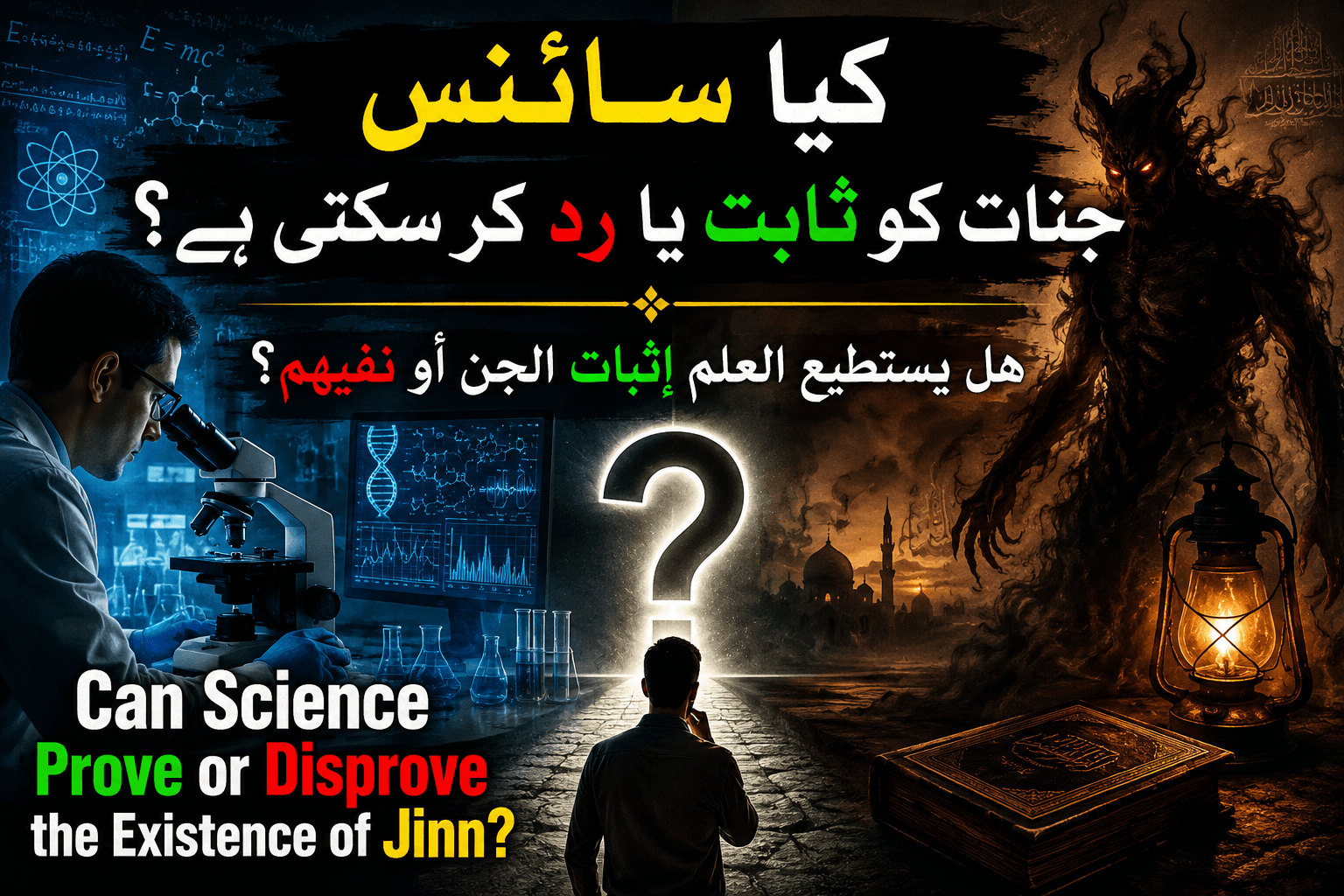
One of the most widespread misconceptions in the modern world is the belief that science's silence about jinn is evidence of their non-existence. In reality, this conclusion is neither scientific nor logically valid. Science is a method of inquiry that investigates only those phenomena which can be observed, measured, tested, and experimentally verified. Consequently, its conclusions are confined to the physical world that falls within the reach of empirical investigation. Jinn, however, according to Islamic belief, belong to the unseen realm (the Unseen) rather than the observable material universe. Therefore, if science cannot detect or examine jinn through its current methods and instruments, this does not imply that they do not exist; it merely indicates that the subject lies beyond the scope of empirical science. The inability of an instrument to detect something does not prove that the thing itself is nonexistent—it simply reveals the limitations of the instrument. For example, if someone uses a metal detector and fails to discover a diamond, it would be irrational to conclude that no diamond exists. The device was never designed to detect diamonds in the first place. The same reasoning applies to jinn. Science's inability to observe or verify them does not constitute evidence against their existence, because the question itself extends beyond empirical science into the domains of metaphysics and the unseen. Therefore, the statement, "Science has not proven the existence of jinn; therefore, jinn do not exist," is not a scientific conclusion but a philosophical assertion presented under the guise of science. Intellectual honesty requires us to recognize both the remarkable power and the inherent limits of science. Not everything that exists is necessarily accessible to scientific experimentation, and every field of knowledge has its own appropriate methods of investigation.
Have a question about this post?
Ask a Question
About the Author
Muhammad Awais
By the boundless grace and guidance of Allah Almighty, Muhammad Awais is associated with the noble journey of teaching, research, and writing. In his quest to quench his thirst for knowledge, he has completed the Dars-e-Nizami (Traditional Islamic Education), an MA in English, an M.Phil in Islamic Studies, and a B.Ed. Currently, he is pursuing his Ph.D. in Islamic Studies at Hazara University. The core of his academic interests primarily revolves around Islamic Sciences, Western Philosophy, contemporary intellectual discourses, Ilm al-Kalam (Islamic Scholastic Theology), and both classical and modern logic—subjects he continuously strives to comprehend more deeply and reflect upon. His association as a 'Master Trainer' with the British Council and other local institutions, coupled with his experience in competitive examinations, has acquainted him with a diverse array of academic disciplines, for which he is profoundly grateful to the Lord of Majesty. With his very limited abilities, he is making a humble effort to contribute a small share towards serving knowledge, offering intellectual guidance, and fostering an environment of positive academic dialogue. It is his heartfelt prayer that the Lord of the Worlds graciously accepts these modest and fragmented efforts in His Divine Presence, and makes this knowledge beneficial for His creation. Ameen.