
Were Muslim Scientists Persecuted Because of Science?
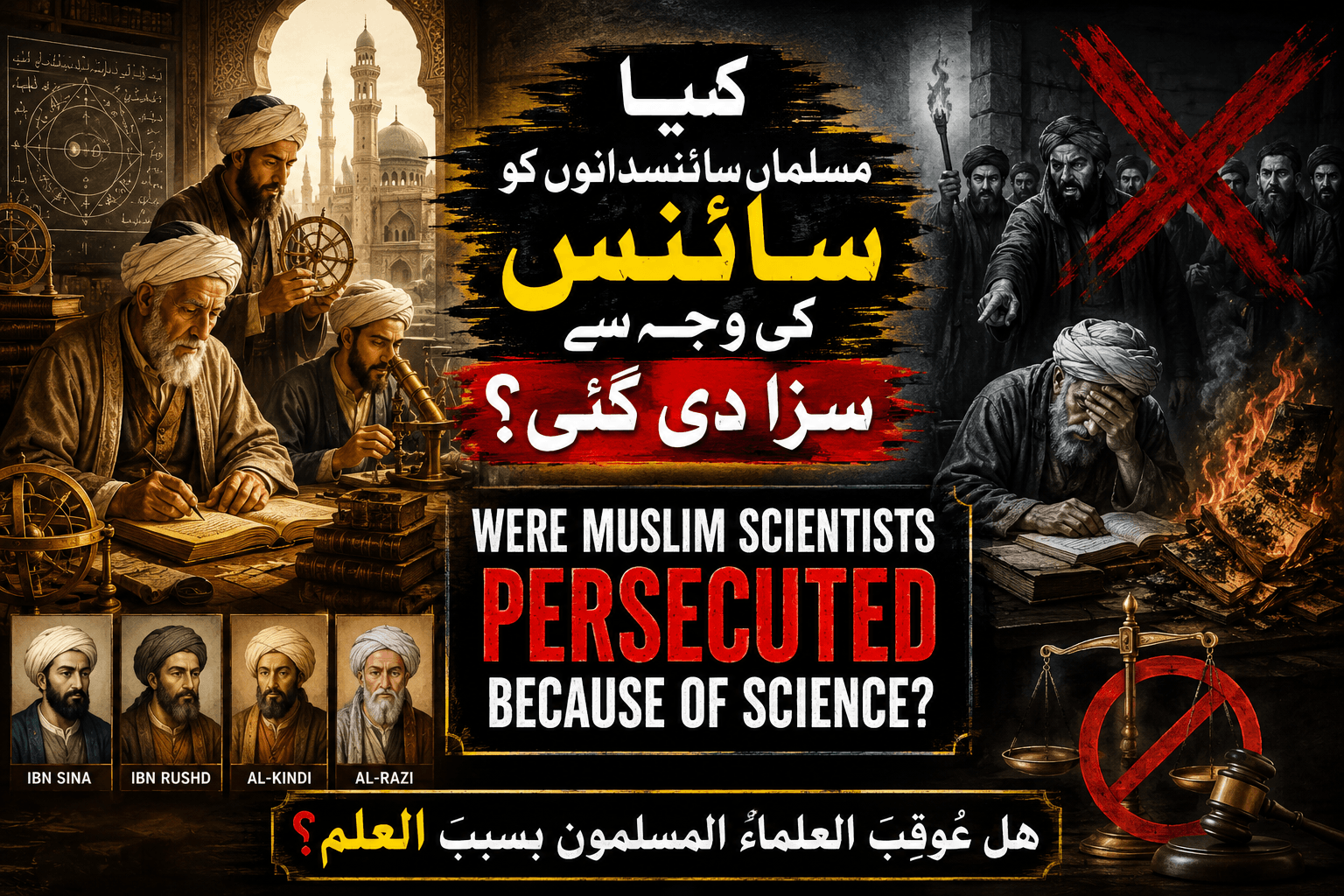
One of the established principles of historiography is that when a civilization experiences intellectual or political decline, victorious civilizations often reinterpret its history through the lens of their own historical experiences. In the nineteenth century, the European historians John William Draper and Andrew Dickson White formulated what later became known in the history of science as the Conflict Thesis. According to this theory, religion and science have historically existed in a perpetual state of conflict, with religious institutions consistently attempting to suppress scientific progress.
This theory, however, emerged from the particular historical experience of medieval Europe, where the Church came into conflict with figures such as Galileo Galilei and Giordano Bruno. Unfortunately, many modern Orientalists and contemporary atheist writers have projected this uniquely European narrative onto Islamic history without sufficient historical scrutiny. They frequently argue that the leading scholars of the Islamic Golden Age were rebels against their own society and that they were condemned, imprisoned, or exiled because of their scientific achievements.
A careful examination of historical evidence, however, reveals a very different picture. When the lives of these scholars are studied individually rather than through broad generalizations, it becomes clear that the difficulties they encountered were rarely connected with their scientific discoveries. Instead, they usually arose from political rivalries, court intrigues, or philosophical and theological controversies concerning metaphysical questions. Consequently, portraying these incidents as evidence of Islam's alleged hostility toward science constitutes a clear category error, confusing political or theological disputes with opposition to empirical science.
One of the most common objections asserts that the expression "Islamic Science" is itself an oxymoron. According to this claim, scholars such as Avicenna (Ibn Sīnā), Averroes (Ibn Rushd), Al-Kindī, and Al-Rāzī were not genuine representatives of Islamic civilization but merely followers of Greek philosophy. Their scientific contributions, it is argued, were rejected by Muslim society; their books were burned, and they themselves were persecuted because of their scientific ideas. Therefore, these achievements should not be attributed to Islamic civilization but rather to individuals who supposedly succeeded despite Islam, not because of it.
Historical evidence, however, tells a substantially different story.
Avicenna (Ibn Sīnā)
The Objection
It is frequently claimed that Avicenna was branded a heretic because of his medical and scientific writings, spent his life fleeing from one city to another, and eventually lived in imprisonment and isolation.
The Response
Avicenna was not merely a physician; he was also an influential statesman who served as vizier and royal adviser under several dynasties, including the Samanids and the Buyids. Eleventh-century Persia was marked by continual political instability, succession crises, and military conflicts. Whenever a ruler was overthrown, members of the previous administration often became targets of political retaliation.
Avicenna's imprisonment in the fortress of Hamadan resulted from secret political correspondence with the ruler of Isfahan, ʿAlāʾ al-Dawla, an act interpreted by the ruling authority as political betrayal. His periods of exile and concealment therefore stemmed from court politics rather than scientific activity. Significantly, his monumental medical encyclopedia, The Canon of Medicine (Al-Qānūn fī al-Ṭibb), was never prohibited because of its scientific content. Instead, it became the standard medical textbook throughout the Islamic world and later across Europe for several centuries.
Averroes (Ibn Rushd)
The Objection
It is alleged that Averroes was declared an unbeliever, publicly humiliated in Córdoba, and that all of his scientific works were burned.
The Response
Averroes served as the Chief Judge (Qāḍī al-Quḍāt) of Córdoba and was one of the closest advisers to the Almohad Caliph Abū Yūsuf Yaʿqūb al-Manṣūr. His temporary exile in 1195 occurred during one of the most politically sensitive periods in Andalusian history. Christian armies were preparing major campaigns against Muslim territories, and the caliph urgently required the support of the Mālikī religious establishment and the general population.
Some conservative scholars objected to Averroes' philosophical commentaries on Aristotle's metaphysics. In response, the caliph temporarily exiled him as a political measure intended to preserve internal unity during wartime. Once the external threat had subsided, Averroes was officially recalled, reinstated to his former positions, and restored to royal favor.
Furthermore, historical evidence does not support the claim that all his books were destroyed. Only a limited number of his philosophical writings dealing with metaphysical issues were reportedly targeted, while his works on medicine, astronomy, jurisprudence, and other sciences continued to circulate widely throughout the Islamic world.
Al-Kindī
The Objection
It is often claimed that Al-Kindī was publicly flogged and that his famous private library was confiscated because he promoted science and philosophy.
The Response
Al-Kindī's difficulties must be understood within the broader political context of the Mihna (the Inquisition concerning the createdness of the Qur'an). During the reigns of al-Maʾmūn, al-Muʿtaṣim, and al-Wāthiq, the Muʿtazilite theological school enjoyed official state patronage, while traditional scholars such as Imam Aḥmad ibn Ḥanbal suffered persecution.
Al-Kindī was closely associated with this intellectual establishment. When Caliph al-Mutawakkil reversed state policy and dismantled Muʿtazilite influence, numerous figures connected with the previous regime experienced political repercussions. Consequently, Al-Kindī's temporary disgrace resulted from political realignment rather than from his work in mathematics, astronomy, medicine, or natural philosophy. His library was later returned, and his official patronage was restored.
Al-Rāzī (Rhazes)
The Objection
A popular story claims that Al-Rāzī was beaten on the head with one of his own books until he became blind and eventually died as a consequence.
The Response
This story belongs more to historical legend than to documented history. No reliable primary historical source confirms such an event.
Al-Rāzī was among the most celebrated physicians of his age and served as director of the major hospitals of Baghdad and Rayy. According to medical historians, especially Ibn Abī Uṣaybiʿah, his blindness resulted from cataracts in old age. Al-Rāzī himself described the deterioration of his eyesight, attributing it to years of intensive reading and prolonged exposure to chemical vapors during laboratory experiments. There is no credible historical evidence that he was blinded as a judicial punishment for his scientific work.
The Distinction Between Science and Metaphysics
A crucial distinction must be maintained between empirical science and metaphysical philosophy. Classical Muslim scholars never opposed disciplines such as medicine, mathematics, astronomy, optics, engineering, or other sciences founded upon observation and demonstrative proof.
Even Abū Ḥāmid al-Ghazālī, who is frequently but incorrectly accused of causing the decline of Islamic science, explicitly states in Al-Munqidh min al-Ḍalāl (Deliverance from Error) that anyone who believes Islam must be defended by denying established mathematical or medical truths actually harms religion rather than serves it, because such sciences rest upon demonstrative certainty.
The genuine disagreements concerned certain philosophical doctrines inherited from Aristotle and Plato—such as the eternity of the universe or the denial of bodily resurrection—which conflicted with Islamic revelation. These debates belonged to theology and metaphysics rather than to empirical scientific investigation.
Conclusion
Historical evidence clearly demonstrates that the widespread claim that Muslim scientists were persecuted because of their scientific discoveries is not supported by careful historical research. Rather, it largely results from projecting the European experience of Church–science conflict onto Islamic civilization.
The documented cases show that the hardships experienced by some Muslim scholars were primarily consequences of political struggles, administrative rivalries, or theological disagreements—not their contributions to medicine, mathematics, astronomy, chemistry, or other empirical sciences. Their scientific works continued to be studied in Islamic hospitals, universities, and libraries for centuries and later played a significant role in the scientific awakening of Europe.
Therefore, portraying Islam and science as inherently antagonistic is neither historically accurate nor intellectually sustainable. It reflects a selective reading of history shaped more by the European historical experience than by the realities of Islamic civilization.
References
· Al-Ghazālī, Abū Ḥāmid. Al-Munqidh min al-Ḍalāl (Deliverance from Error). Edited by Jamil Saliba and Kamil Ayyad. Damascus: Maktabat al-Nashr al-Thaqāfī, 1939.
· Al-Hassan, Ahmad Y., ed. Science and Technology in Islam. Vol. 4, The Different Aspects of Islamic Culture. Paris: UNESCO Publishing, 2001.
· Ibn Abī Uṣaybiʿah, Aḥmad ibn al-Qāsim. ʿUyūn al-Anbāʾ fī Ṭabaqāt al-Aṭibbāʾ (The Literary History of Medicine). Edited by August Müller. Cairo: al-Maṭbaʿah al-Wahbiyyah, 1882.
· Nasr, Seyyed Hossein. Science and Civilization in Islam. Cambridge, MA: Harvard University Press, 1968.
· Saliba, George. Islamic Science and the Making of the European Renaissance. Cambridge, MA: MIT Press, 2007.
Have a question about this post?
Ask a Question
About the Author
Muhammad Awais
By the boundless grace and guidance of Allah Almighty, Muhammad Awais is associated with the noble journey of teaching, research, and writing. In his quest to quench his thirst for knowledge, he has completed the Dars-e-Nizami (Traditional Islamic Education), an MA in English, an M.Phil in Islamic Studies, and a B.Ed. Currently, he is pursuing his Ph.D. in Islamic Studies at Hazara University. The core of his academic interests primarily revolves around Islamic Sciences, Western Philosophy, contemporary intellectual discourses, Ilm al-Kalam (Islamic Scholastic Theology), and both classical and modern logic—subjects he continuously strives to comprehend more deeply and reflect upon. His association as a 'Master Trainer' with the British Council and other local institutions, coupled with his experience in competitive examinations, has acquainted him with a diverse array of academic disciplines, for which he is profoundly grateful to the Lord of Majesty. With his very limited abilities, he is making a humble effort to contribute a small share towards serving knowledge, offering intellectual guidance, and fostering an environment of positive academic dialogue. It is his heartfelt prayer that the Lord of the Worlds graciously accepts these modest and fragmented efforts in His Divine Presence, and makes this knowledge beneficial for His creation. Ameen.