
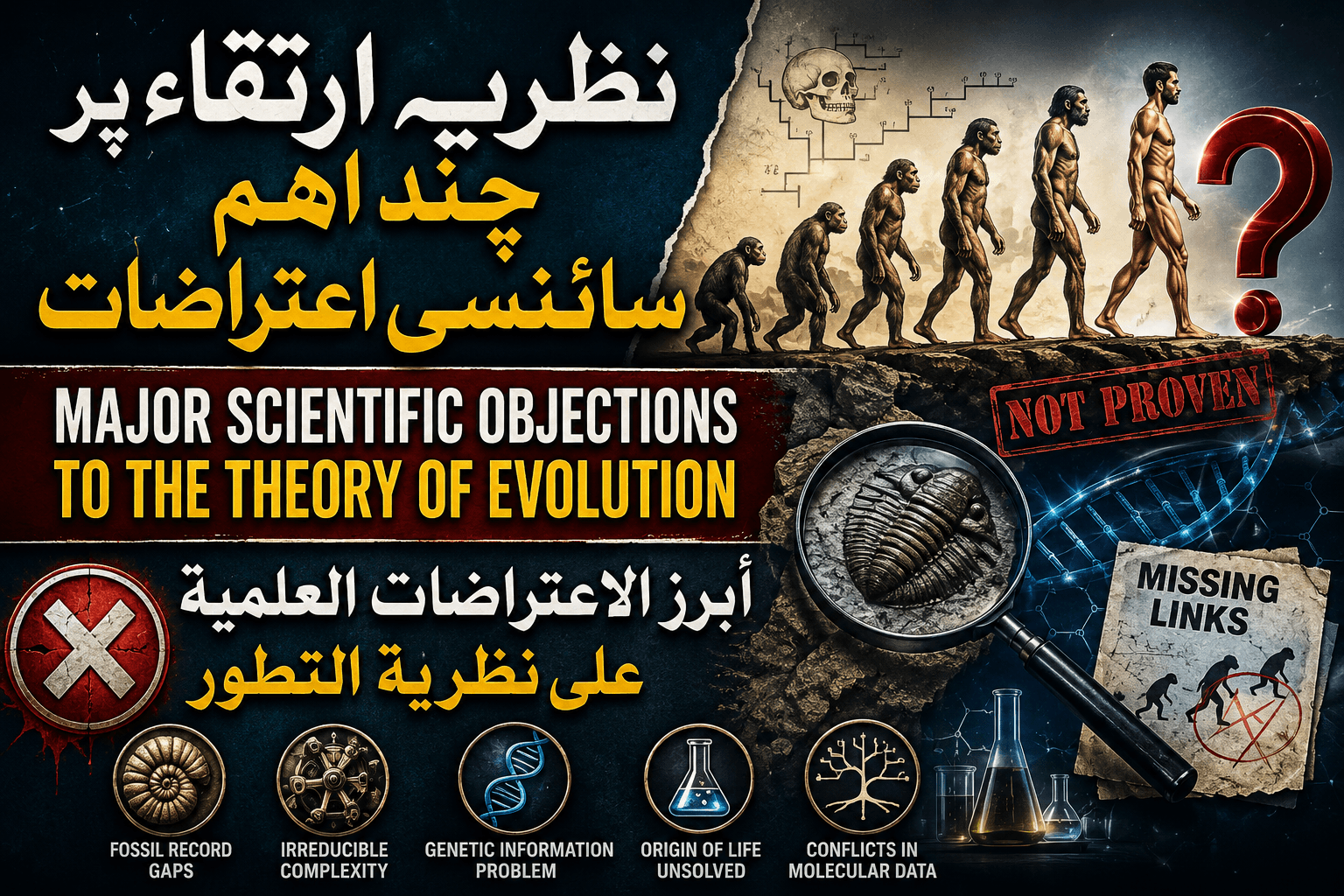
Major Scientific Objections to the Theory of Evolution
What Is the Theory of Evolution?
According to the prevailing scientific understanding, the Theory of Evolution proposes that all living organisms on Earth descend from a Common Ancestor and have diversified over vast periods of time through genetic mutations, environmental changes, and the process of natural selection.
In simple terms, the theory suggests that living organisms gradually adapt to their environments in order to survive. Beneficial inherited traits accumulate across successive generations, and over millions of years these accumulated changes may give rise to entirely new species. According to this framework, human beings also emerged through a long evolutionary process that began with primitive life forms and eventually resulted in modern humans with their present physical and cognitive characteristics.
Is the Theory of Evolution Scientifically Robust?
To understand the scientific and philosophical criticisms directed against the Theory of Evolution, it is necessary to examine several major issues that, according to a number of researchers, challenge some of its underlying assumptions in light of contemporary scientific discussions.
The following is a summary of these criticisms together with their logical analysis.
1. The Cambrian Explosion and the Fossil Record
Classical Darwinian evolution maintains that life originated in simple forms and gradually evolved into increasingly complex organisms through slow, incremental changes (gradualism) over millions of years.
Criticism:
According to many geologists and paleontologists, the Cambrian Explosion witnessed the relatively sudden appearance of numerous complex organisms possessing sophisticated anatomical structures and biological systems. Critics argue that the fossil record lacks many of the expected intermediate transitional forms that should document the gradual evolutionary process proposed by Darwin. They regard this apparent abrupt emergence as a significant challenge to classical Darwinian evolution.
2. Irreducible Complexity
The concept of irreducible complexity argues that certain biological systems consist of multiple interdependent components, such that removing any one component renders the entire system nonfunctional.
Criticism:
Frequently cited examples include the human eye, the blood-clotting cascade, and certain molecular machines within living cells. Critics ask how such systems could have evolved through numerous successive, unguided modifications if they cannot function until all of their essential parts are simultaneously present.
3. The Origin of Genetic Information
Evolutionary theory relies upon genetic mutations as the primary source of biological variation.
Criticism:
Critics argue that mutations generally damage, reduce, or alter existing genetic information rather than generate substantial amounts of new, functionally meaningful genetic information. They further contend that the highly sophisticated information encoded within DNA resembles an intelligently organized information system, making it difficult to explain solely through accumulated random mutations.
4. The Origin of Life (Abiogenesis)
The Theory of Evolution attempts to explain how existing organisms diversified after life already existed; it does not, by itself, explain how the first living organism originated.
Criticism:
According to critics, the hypothesis of abiogenesis—the emergence of life from non-living matter—has not yet been experimentally demonstrated. They argue that laboratory experiments, including the famous Miller–Urey experiment, have not produced living cells nor fully explained the transition from chemistry to biology. Consequently, the origin of life remains one of the most challenging unresolved questions in modern biology.
5. Molecular Biology and the Tree of Life
Charles Darwin proposed the Tree of Life primarily on the basis of observable anatomical similarities among living organisms.
Criticism:
Advances in molecular biology have revealed that genetic relationships do not always correspond perfectly with classifications based on physical characteristics. Critics maintain that these discrepancies raise important questions regarding the traditional evolutionary tree and whether it adequately represents the evolutionary relationships among all living organisms.
Summary of These Criticisms
The principal criticisms may be summarized as follows:
Insufficient Observational Evidence: Critics argue that the fossil record does not contain all of the transitional forms expected under gradual evolutionary theory.
Limitations of the Proposed Mechanism: They contend that natural selection can preserve or eliminate existing traits but cannot, by itself, account for the origin of fundamentally new biological information or highly complex biological systems.
Evidence Suggestive of Design: The remarkable organization, coordination, and complexity of biological systems are viewed by some researchers as being more consistent with purposeful design than with an undirected sequence of random events.
These criticisms represent the perspective of a number of scientists and scholars who consider the classical Darwinian model insufficient to explain every aspect of biological complexity and diversity, and who continue to search for broader explanatory models. At the same time, it should be noted that many evolutionary biologists maintain that these objections have been substantially addressed within contemporary evolutionary research and continue to regard evolutionary theory as the most comprehensive scientific framework for explaining the diversity of life.
Have a question about this post?
Ask a Question
About the Author
Muhammad Awais
By the boundless grace and guidance of Allah Almighty, Muhammad Awais is associated with the noble journey of teaching, research, and writing. In his quest to quench his thirst for knowledge, he has completed the Dars-e-Nizami (Traditional Islamic Education), an MA in English, an M.Phil in Islamic Studies, and a B.Ed. Currently, he is pursuing his Ph.D. in Islamic Studies at Hazara University. The core of his academic interests primarily revolves around Islamic Sciences, Western Philosophy, contemporary intellectual discourses, Ilm al-Kalam (Islamic Scholastic Theology), and both classical and modern logic—subjects he continuously strives to comprehend more deeply and reflect upon. His association as a 'Master Trainer' with the British Council and other local institutions, coupled with his experience in competitive examinations, has acquainted him with a diverse array of academic disciplines, for which he is profoundly grateful to the Lord of Majesty. With his very limited abilities, he is making a humble effort to contribute a small share towards serving knowledge, offering intellectual guidance, and fostering an environment of positive academic dialogue. It is his heartfelt prayer that the Lord of the Worlds graciously accepts these modest and fragmented efforts in His Divine Presence, and makes this knowledge beneficial for His creation. Ameen.