
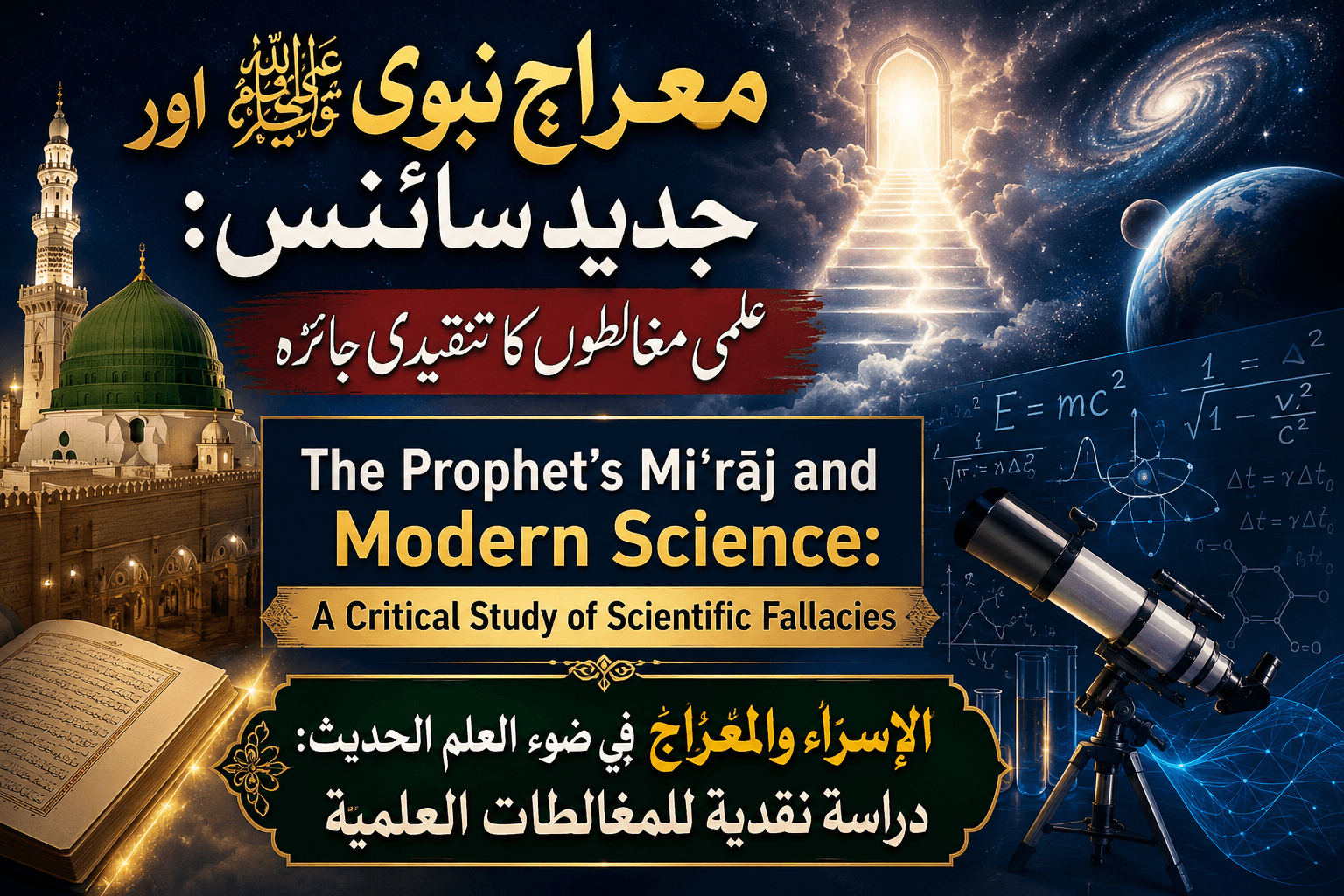
The Prophet’s Miʿrāj and Modern Science: A Critical Study of Scientific Fallacies
The Miʿrāj (Ascension) of the Prophet Muḥammad ﷺ is the greatest supernatural event in human history. During this miraculous journey, the Messenger of Allah ﷺ transcended the limits of the material universe within a remarkably short period of earthly time and reached stations of divine proximity that lie far beyond ordinary human comprehension and imagination. This was not merely a spiritual vision or mystical dream; rather, according to the mainstream Islamic tradition, it was a real journey undertaken both physically and spiritually. Throughout history, scholars and thinkers have examined this extraordinary miracle from different intellectual and methodological perspectives.
In the modern era, however, two opposing extremes have emerged in evaluating the Miʿrāj through the lens of science. One seeks to reject the miracle on scientific grounds, while the other attempts to validate it entirely through contemporary scientific theories. Both approaches suffer from significant methodological shortcomings and therefore require careful scholarly examination.
The First Scientific Fallacy
The Scientific Denial of the Miʿrāj
(A Critique of the Materialistic and Atheistic Perspective)
The primary objection raised by modern materialistic and atheistic thought is that the Miʿrāj is incompatible with the established laws of physics. Advocates of this view argue that a physical journey beyond Earth's orbit would necessarily require overcoming gravity, surviving the vacuum of space where oxygen is absent, enduring intense cosmic radiation, and withstanding extreme temperatures. From this perspective, they contend that it is scientifically impossible for a human being to traverse the universe physically within a matter of moments.
Response
The fundamental flaw in this objection is its failure to distinguish between a miracle and a natural law.
By definition, a miracle is an extraordinary act that does not operate within the ordinary framework of natural causation. Rather, it occurs through the direct and unlimited power of the Creator, who established the laws of nature and therefore possesses absolute authority to suspend, transcend, or override them whenever He wills. Consequently, it is methodologically incorrect to evaluate a divine miracle solely according to the regularities that govern the physical universe.
Indeed, if human beings, despite their limited intellect and imperfect technology, have managed to overcome the effects of gravity to a considerable extent, land on the Moon, and send spacecraft to Mars and beyond, then it is hardly rational to claim that the Creator of the universe is incapable of elevating His chosen Messenger ﷺ beyond all material constraints. The One who created the laws of nature is not Himself subject to those laws.
Furthermore, the scope of empirical science is inherently limited to observable, measurable, and repeatable phenomena within the four-dimensional physical universe (space-time). Science can describe what ordinarily occurs within nature, but it cannot pronounce absolute judgments concerning realities that lie beyond its methodological domain. Therefore, to deny the possibility of a supernatural event merely because it falls outside empirical observation is not an application of science itself; rather, it is an expression of scientism—the philosophical assumption that empirical science is the only valid source of knowledge. Such a claim exceeds the legitimate boundaries of the scientific method and transforms a methodological tool into a comprehensive worldview.
The Second Scientific Fallacy
Attempting to Prove the Miʿrāj through Modern Science
(A Critique of the Apologetic Approach)
At the opposite extreme are some Muslim thinkers and exegetes who attempt to explain—or even prove—the Miʿrāj entirely through the known laws of the physical universe. They appeal to modern scientific theories such as Einstein's Theory of Relativity, time dilation, and certain interpretations of quantum physics. Their argument is that since time slows down as an object approaches the speed of light, the apparent suspension or compression of time during the Night of Miʿrāj can be regarded as scientifically demonstrable.
Response
Although this apologetic approach is often motivated by a sincere desire to defend Islam before the modern scientific mind, it is methodologically, intellectually, and theologically problematic. Rather than strengthening faith, it may inadvertently weaken the very concept of miracle that it seeks to defend.
1. The Provisional Nature of Scientific Theories
Scientific theories are not immutable truths. Rather, they are explanatory models that remain open to revision, refinement, or even rejection in light of new empirical evidence. Modern science itself is built upon the principle of falsifiability, meaning that every scientific theory remains subject to critical testing and potential revision.
If divine miracles are made dependent upon a particular scientific theory, the credibility of those miracles may appear to rise and fall with the fortunes of that theory. Should a currently accepted scientific model later be modified or abandoned, some may mistakenly conclude that the miracle itself has been undermined. Such an approach places revealed truths upon a foundation that is, by its very nature, provisional and subject to change.
2. Undermining the Nature of a Miracle
An even more fundamental problem is that explaining a miracle entirely through established physical laws effectively deprives it of its miraculous character.
A miracle, in Islamic theology, is an extraordinary act performed by Allah that transcends the ordinary operation of natural laws in order to confirm the truthfulness of His prophets. If the Miʿrāj were merely the natural consequence of relativity, time dilation, or any other known physical phenomenon, then it would cease to be a supernatural sign (āyah) and would instead become nothing more than a remarkable yet entirely natural scientific event.
Such an interpretation diminishes the unique theological significance of the Miʿrāj by reducing an act of divine intervention to a phenomenon explainable within the ordinary framework of physics. Consequently, instead of safeguarding the miracle, this approach risks stripping it of its essential nature as a manifestation of Allah's limitless power operating beyond the constraints of the created order.
The Correct Rational and Faith-Based Position
Science as a Means of Demonstrating Possibility, Not as Proof
The balanced and intellectually sound position of Islamic thought is that modern scientific discoveries should not be employed as proof of the Prophet's Miʿrāj. Rather, they may be used to demonstrate to the modern materialistic mind that the event is not logically impossible (logically impossible), even though it transcends the ordinary laws of nature.
The authenticity of the Miʿrāj rests upon divine revelation and the established truthfulness of the Prophet Muḥammad ﷺ—not upon the findings of empirical science. Scientific theories, therefore, serve only a secondary and illustrative role: they help remove the assumption that such an event is rationally inconceivable, but they do not constitute evidence for its historical occurrence or theological validity.
In this context, Einstein's Theory of Relativity, together with the reflections of Muslim theologians such as Bediuzzaman Said Nursi on the nature of time, suggests that time is not an absolute and universally fixed reality. Rather, it is relative and may vary according to different cosmic conditions and frames of reference. Likewise, if a being travels under laws that belong to a higher order of existence—whether associated with light, the soul, or the divine realm—the ordinary space-time continuum governing the physical universe may no longer apply in the same manner.
Moreover, developments in quantum physics and theoretical discussions concerning higher dimensions have expanded humanity's understanding of reality by demonstrating that the universe may encompass levels of existence and governing principles that lie beyond the limits of our ordinary four-dimensional perception. These scientific perspectives do not prove the occurrence of the Miʿrāj; rather, they illustrate that reality may be far richer and more complex than classical materialism once assumed.
Consequently, such scientific theories should never be regarded as the foundation of faith. Their value lies only in providing an intellectual response to the materialistic claim that miracles are inherently impossible. They challenge the arrogance of scientism, which mistakenly assumes that the limits of empirical observation are identical with the limits of reality itself.
Conclusion
The Miʿrāj is, above all, an article of faith rooted in belief in the unseen (īmān bil-ghayb) and in absolute trust in the infinite power of Allah, the Lord of the Worlds.
Those who reject the Miʿrāj solely because it appears to conflict with modern scientific understanding fail to recognize the methodological limits of empirical science. Conversely, those who attempt to force the miracle into contemporary scientific equations inadvertently diminish its supernatural character and theological significance.
The Miʿrāj did not occur because it conformed to the laws of physics; it occurred by the direct command and omnipotent will of the One who created those very laws. The Creator is never subject to the order that He Himself has established. Therefore, the miracle should be understood not as an event confined within the framework of physical laws, but as a manifestation of the unlimited power of the One who governs and transcends them.
References
· Efe, A. (2024). A Multidisciplinary Discussion on the Theory of Relativity and the Miʿraj. International Journal of Multidisciplinary Studies and Innovative Technologies, 8(2), 99–108.
· Bari, I., Sultana, T., Channa, A. Q., et al. (2024). Analytical Study of the Miraculous Night Journey and the Mystery of Time Travel in the Light of Science. Remittances Review, 9(1), 1825–1834.
Have a question about this post?
Ask a Question
About the Author
Muhammad Awais
By the boundless grace and guidance of Allah Almighty, Muhammad Awais is associated with the noble journey of teaching, research, and writing. In his quest to quench his thirst for knowledge, he has completed the Dars-e-Nizami (Traditional Islamic Education), an MA in English, an M.Phil in Islamic Studies, and a B.Ed. Currently, he is pursuing his Ph.D. in Islamic Studies at Hazara University. The core of his academic interests primarily revolves around Islamic Sciences, Western Philosophy, contemporary intellectual discourses, Ilm al-Kalam (Islamic Scholastic Theology), and both classical and modern logic—subjects he continuously strives to comprehend more deeply and reflect upon. His association as a 'Master Trainer' with the British Council and other local institutions, coupled with his experience in competitive examinations, has acquainted him with a diverse array of academic disciplines, for which he is profoundly grateful to the Lord of Majesty. With his very limited abilities, he is making a humble effort to contribute a small share towards serving knowledge, offering intellectual guidance, and fostering an environment of positive academic dialogue. It is his heartfelt prayer that the Lord of the Worlds graciously accepts these modest and fragmented efforts in His Divine Presence, and makes this knowledge beneficial for His creation. Ameen.